
As a registered nurse in the Blessing Hospital Emergency Department, Kelli Terwelp has spent years caring for patients in critical moments. Through her work, she has become very familiar with many conditions including stroke care, working with patients for assessments and interventions in the emergency department. But even with that experience, Kelli never expected to become a stroke patient herself. 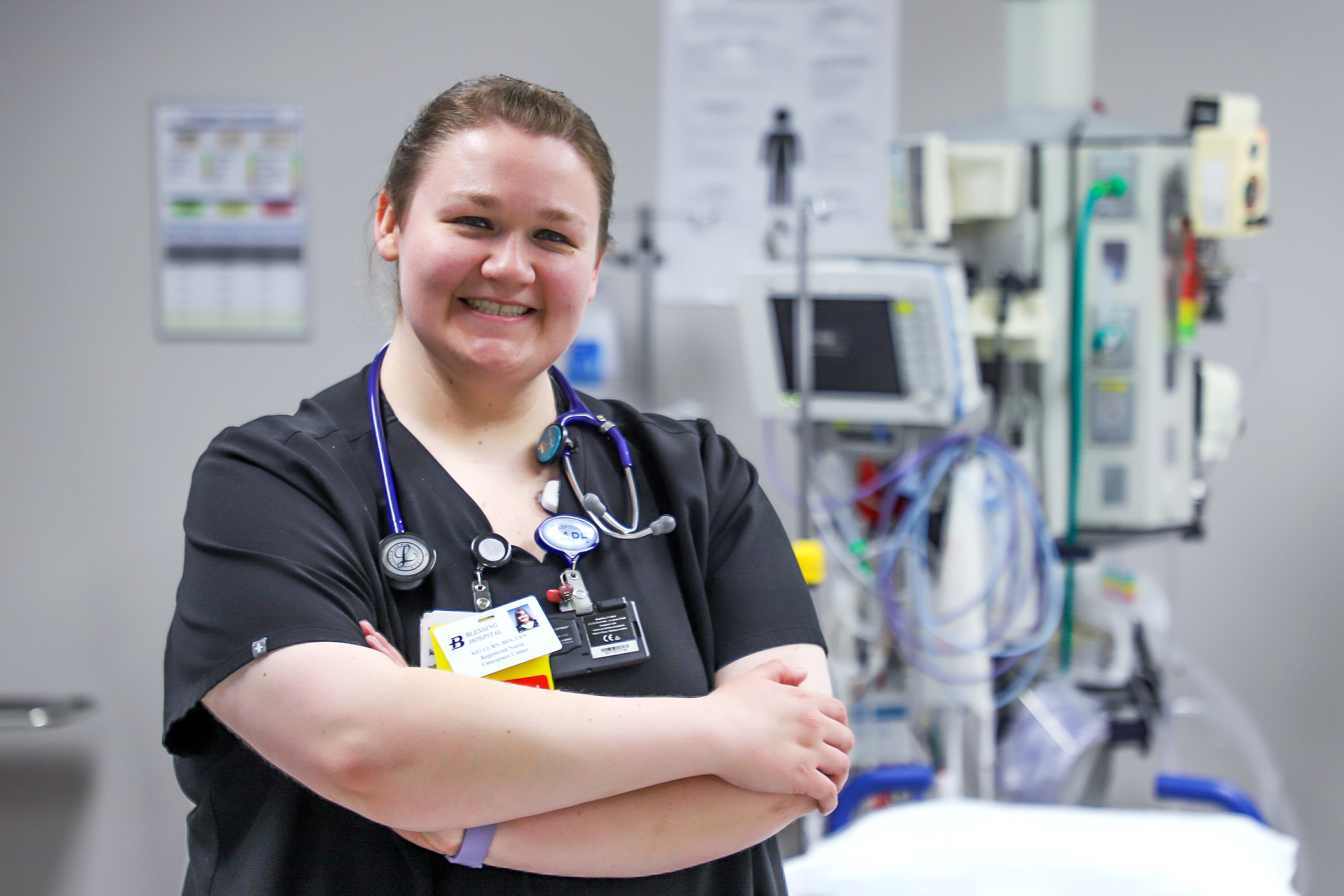 In February 2024, Kelli began to notice that something wasn’t quite right.
“For a few days, I was experiencing nausea, despite medications, and having trouble staying awake,” she says.
Kelli consulted a nurse practitioner at Blessing, who suggested she have an MRI, which was scheduled for the following day. But she wasn’t prepared for what the results would reveal.
To her shock, Kelli had suffered an infarct stroke, also known as an “ischemic stroke.” It’s a type of stroke that occurs when a blood vessel in the brain becomes blocked, which cuts off blood flow and oxygen to the brain, causing affected brain tissue to die.
Thankfully, in coordination with her care team, Kelli recovered and continued on with life with minimal disruption. But just a year later, another unexpected event would occur – this time while Kelli was nine weeks pregnant, making the situation particularly concerning.
In November 2025, Kelli was going about her daily routine when she noticed a sudden numbness taking over the left side of her body. She decided to take her blood pressure before she began experiencing limb weakness, slurred speech, and the left side of her face drooping – all telltale signs of a stroke. Recognizing the symptoms, Kelli acted quickly to seek evaluation and treatment at Blessing’s emergency department.
“This was the first time I had ever experienced these symptoms,” she says. “With my history of stroke and my current pregnancy, I knew I should go in and get evaluated immediately.”
She recalls her arrival at the Blessing as “so smooth,” with her care team springing into action and coordinating across departments and multiple teams to complete evaluations, imaging, and a care plan.
Being on the other side of that healthcare experience left a lasting, positive impact on Kelli, but it’s one she hopes she doesn’t have to endure again.
“After being diagnosed with a stroke, the idea of ‘it only happens later in life’ belief doesn’t hold up anymore,” Kelli says. “My mindset shifted from ‘that won’t happen to me’ to ‘this can happen to anyone, including me, at any time.’”
That perspective now shapes both her personal life and her work. She has utilized her experience to help continue shaping her approach to care, encouraging others to take stroke risk seriously and act quickly if symptoms appear.
“The idea of ‘that could never happen to me’ is one of the biggest risks when it comes to strokes,” she says. “Pay attention to the basics of your health, even if you feel fine. The biggest thing to understand is how time-sensitive a stroke is. The faster it’s recognized and treated, the better the outcome. Minutes truly matter.”
About Stroke and Stroke Awareness Month
May is Stroke Awareness Month, a crucial time to highlight that a stroke occurs every 40 seconds in the U.S. While it is a leading cause of long-term disability and death, up to 80% of strokes are preventable. Knowing the warning signs and acting quickly is the key to survival. Learn more about stroke at blessinghealth.org/stroke