
The sensation of one’s heart fluttering. It’s the stuff dreams are made of, right Not always.
Just ask Maria Baker. For six years, the 58-year-old Blessing Health System administrative secretary lived with that feeling but not knowing why.
“I felt something funny with my heart,” she said. “It didn’t feel like it was beating right. There was no sense my heart was racing. But I could feel a flutter.”
The spells would come about once a year, last no more than an hour and then go away. They were annoying but did not interfere with Maria living her life to the fullest.
“It was not something I went to the doctor for. I just thought it was blood pressure related,” Maria noted, as she was on blood pressure medication.
Fast forward to summer 2025. Those once-a-year heart spells suddenly hit twice in one month and lasted longer than in years past. During one of the spells, Maria’s daughter, a nurse, checked her mom’s heart rate. It was 120 beats per minute. On Maria’s smart watch, she saw her heart rate then jump another 20 beats. The normal resting heart rate for a woman Maria’s age is 60-100 beats. Her daughter suggested a visit to the Blessing Emergency Center, a nationally-accredited Chest Pain Center.
Maria left the Emergency Center with a referral to see Dr. John Hammock, a Blessing Heart & Vascular Center board-certified cardiologist and electrophysiologist.
Maria gets her answer
“Dr. Hammock said I had atrial flutter,” she stated.
Atrial flutter is a type of heart rhythm disorder called an arrhythmia. Approximately one in 18 people has an arrhythmia. Complications depend on the type of arrhythmia from which a patient suffers, but may include stroke due to blood clot formation, heart failure and sudden death. Atrial flutter is similar to atrial fibrillation (AFib). But in atrial flutter, the heart rhythm is more organized and less chaotic than in AFib. A person can have both atrial flutter and AFib.
Like most people, Maria knew nothing about atrial flutter. But she did when she left Dr. Hammock’s office.
“He took a piece of paper and drew a heart to explain to me what was happening so that I understood,” she said. “Dr. Hammock is absolutely amazing. He is a very kind, caring person. I never felt like he was rushing to get to the next patient. He took time with me and answered my questions. He just has a good bedside manner.”
To get Maria’s heart back to a consistently normal rhythm required a procedure known as ablation in Blessing’s nationally-accredited Cardiac Electrophysiology (EP) Lab. EP labs and the teams that staff them provide a variety of treatments for arrhythmias.
Ablation is a minimally-invasive procedure during which energy is delivered through catheters to create tiny scars in the heart tissue. Those tiny scars block irregular electrical signals that cause irregular heartbeat.
“It’s kind of terrifying to think about,” Maria said about the medical definition of ablation. “But with everything I heard about Dr. Hammock, I knew I was in good hands.”
Today, Maria’s heart flutter appears to have been short-circuited and she says she feels great.
About Dr. Hammock and the EP Lab
Dr. Hammock is a Quincy native. He holds certification from the American Board of Internal Medicine with added certification in cardiovascular disease and clinical cardiac electrophysiology. He earned his medical degree from Southern Illinois University School of Medicine, completed an internship and residency at the University of Illinois Medical Center, a fellowship at the University of Kentucky Medical Center, and a sub-fellowship in clinical cardiac electrophysiology at the University of Oklahoma Medical Center.
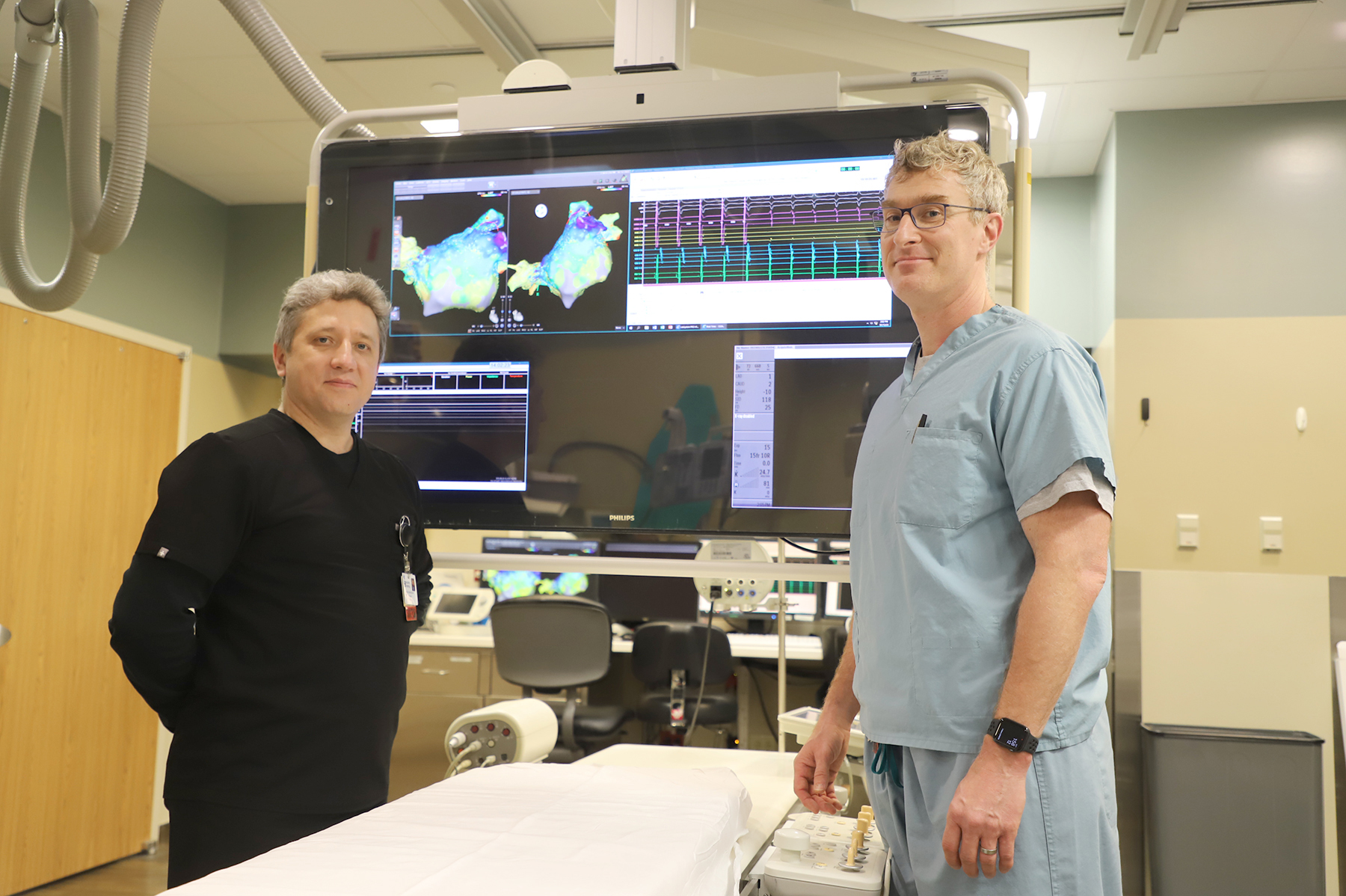
For many years, Tri-State area residents with heart rhythm conditions needed to travel hundreds of miles for EP care. When Dr. Hammock joined Blessing Health, leaders knew he had an interest in cardiac electrophysiology. In 2012, Blessing Health administration approached Dr. Hammock with the idea to apply for an EP fellowship to add another level of heart care Blessing could provide to residents of the region.
“As I watched the Blessing Heart & Vascular Center program grow over the years, I noticed an increasing demand for electrophysiology services,” noted Dr. Hammock. “Seeing a substantial number of our patients leaving for things that could be done at Blessing, I thought, ‘I’m only young once. I might as well give it a shot and do one extra year of training.’”
As Dr. Hammock completed the clinical cardiac electrophysiology fellowship program at the University of Oklahoma Medical Center, a state-of-the-art EP lab was being built, equipped and staffed at Blessing Hospital. Dr. Hammock and team performed the first EP procedure at Blessing in August 2013.
Since that time, Oleg Yurevich, MD, joined the Blessing EP team. He holds certification from the American Board of Internal Medicine with added certification in cardiovascular disease. He completed a general cardiology fellowship at the State University of New York Downstate Health Science University, Brooklyn, and in clinical cardiac electrophysiology at the University of Illinois Chicago.
And a year ago, The Blessing Heart & Vascular Center was awarded EP accreditation by the American College of Cardiology (ACC) for demonstrated expertise in and commitment to treating patients with arrhythmias.
Currently, the Blessing EP lab is one of only 53 ACC accredited facilities in the country and the only one in Illinois. Missouri has no accredited EP labs at this time.
“Blessing’s EP lab team has demonstrated its commitment to providing the communities it serves with excellent heart care,” said Deepak L. Bhatt, MD, MPH, FACC, chair of the ACC Accreditation Management Board.
“This was a huge accomplishment for my team and the patients who need our care,” said Dr. Hammock.
For more information on Blessing’s heart care, go to blessinghealth.org/heart.